Welcome to the Carney Show and His Conflicts of Interest
Mark Carney isn’t walking into Canadian politics with clean hands; he’s dragging a briefcase stuffed with stock options, power connections, and corporate baggage big enough to fill a Brookfield boardroom.
This isn’t the story of a humble civil servant stepping up for national duty. This is the story of a global finance heavyweight, moonwalking into politics with a closet full of million-dollar ties and a history of turning private profits into public influence.
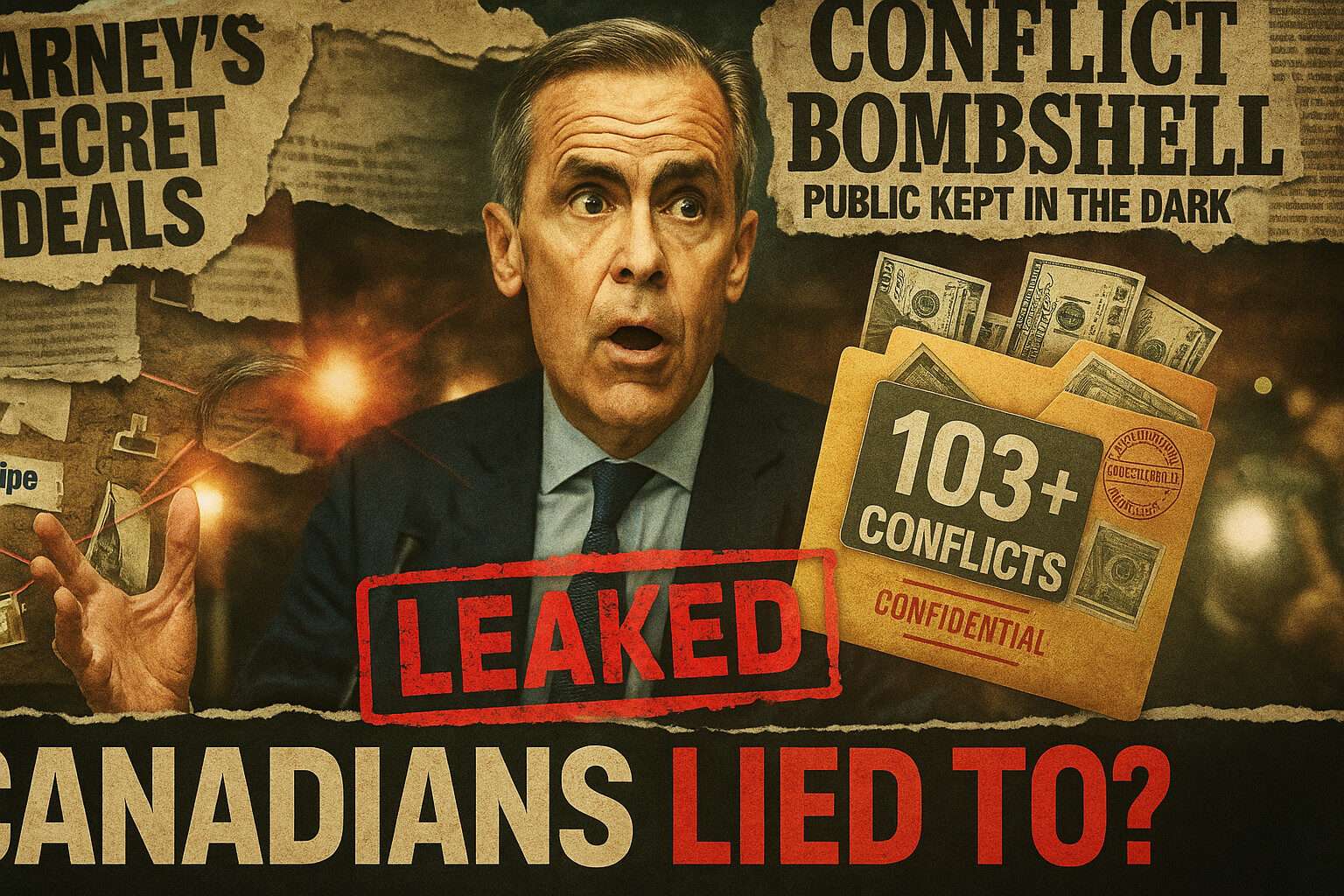
Carney’s resume reads like a Wall Street fantasy novel. Former Governor of the Bank of Canada. Former Governor of the Bank of England. United Nations climate czar. Goldman Sachs alum and a WEF Puppet. Oh, and now, Canada’s Prime Minister. All that power, and yet nobody seems to blink at the fact that this man currently has over 103 declared conflicts of interest, many of them (over 550) directly tied to the private sector giants he once served, and may still profit from.
The Ethics Screen That Isn’t Fooling Anyone

The government claims Carney is protected by an “ethics screen.” That’s the shiny, PR-friendly phrase they’ve slapped on his involvement with Brookfield Asset Management and Stripe, two companies he held senior roles in before rebranding himself as a man of the people.
The screen supposedly blocks him from making decisions that would benefit those companies. Sounds comforting… until you realize it works on the honour system. There’s no independent watchdog peeking over his shoulder. No third-party oversight. His own staff “screens” him from material that could lead to, let’s say, an awkward bonus situation.
And here’s where it gets even weirder: the ethics screen only covers Brookfield and Stripe. Not the hundreds of other companies he’s invested in through his blind trust. Not the real estate holdings. Not the tech stocks. Not the renewable energy plays. So while Canadians are told to trust the screen, the man behind the curtain is still holding the remote.
The Blind Trust That Sees Everything
Let’s talk about this “blind trust.” It sounds noble, like Carney locked away his fortune and tossed the key into the Rideau Canal. In reality, the blind trust is more like tinted glass; it hides the view, not the benefits.
Carney still receives income and capital gains from his holdings. He might not see the day-to-day trades, but he knows where the cash is coming from. And it’s coming from everywhere. According to recent filings, his trust includes equity and stock options from Brookfield, shares in Stripe, and positions in hundreds of companies across sectors, including Tesla, Google, Boeing, and more.
He’s not just diversified. He’s deeply invested. While average Canadians scrape together rent, Carney’s earnings are linked to markets that most people don’t even understand.
Follow the Money to Bermuda

One of the juiciest chapters in this saga is Carney’s connection to Brookfield’s global money machine. Brookfield Asset Management isn’t your local credit union. It’s a corporate octopus with tentacles in everything, real estate, infrastructure, renewables, private equity, and it’s mastered the art of tax minimization through a maze of offshore subsidiaries.
Where, you ask? Bermuda. The land of pink sand, rum swizzles, and no corporate income tax. Brookfield operates through over 500 shell companies, many of them based in Bermuda, letting them shuffle profits out of reach of Canadian tax authorities.
And who used to sit on their board, raking in compensation and equity stakes while these operations grew? You guessed it, Mark Carney. Now that he’s in government, we’re told he’ll recuse himself from decisions involving Brookfield. But the problem isn’t the decisions he makes. It’s the ones he doesn’t have to make to benefit.
Brookfield thrives under government policies like infrastructure spending, real estate incentives, and climate subsidies. If those go up, so does Carney’s legacy portfolio.
Carney’s Climate Cash Cow
Ah, yes, the climate crusader story. Carney has been praised for his work on sustainable finance, that fancy term for turning the climate crisis into a market opportunity. As UN Special Envoy on Climate Action and Finance, he’s rallied corporations to “go green” by investing in clean energy, ESG funds, and carbon offset markets.
Sounds good, right? Until you find out that many of those investments flow into Brookfield’s renewable energy arm, one of the largest in the world. So while he’s waving the climate flag, the wind is blowing money into the very company he helped build and still profits from.
It’s like standing on a podium yelling, “Buy electric!” while holding stock in a lithium mine and quietly high-fiving the CEO behind the curtain.
The Billionaire Whisperer

Carney doesn’t speak for working-class Canadians. He speaks for boardrooms. He’s the guy CEOs call when they want to predict policy before it happens. And now that he’s sitting in the inner circle of Canadian politics, his Rolodex is worth its weight in oil stocks.
We’re not talking about minor ties. We’re talking about someone who sits on international panels, advises investment giants, and writes op-eds about central banking for the Financial Times, all while holding silent stakes in the companies that benefit from his advice.
If that doesn’t make you suspicious, you’re not paying attention!
Canadians Are Starting to Clue In
The public isn’t dumb. People are noticing. Reddit threads, Facebook posts, angry tweet, they’re all lit up with the same question:
“How can this guy lead a country when he’s still leading a financial empire?”
And they’re right to ask.
Carney’s situation isn’t some obscure paperwork issue. It’s the clearest example of power wrapped in profit. It’s a reminder that Canada doesn’t need foreign interference when it has domestic elites shaping policy in boardroom shadows.
The media has largely tiptoed around the issue. Some headlines, sure. A few op-eds. But no big exposés. No hour-long investigative specials. Why? Because this isn’t a scandal in the Hollywood sense. It’s worse. It’s legalized influence that hides behind polite language and professional titles. Plus, we all know how the CBC is funded by the Liberal government, so they’re DEFINATELY not going to stir the pot.
Ethics by Technicality

Let’s be clear, Carney hasn’t been charged with wrongdoing. But that’s the whole problem. The bar is so low that you can hold stock in a company, help shape national policy, and walk away with a smile because your ethics screen says “no problem.”
It’s not illegal. It’s institutionalized advantage. And it’s available to anyone with the connections to make it work.
If a sitting Conservative Prime Minister had direct business ties to foreign companies and investment funds, there’d be outrage. If a cabinet minister held options in Tesla while negotiating EV subsidies, it would be a scandal. So why does Carney get a pass?
Because he plays the game better than anyone. And he’s wrapped himself in just enough climate talk and economic jargon to make it all sound like public service.
A Country for the Connected
What Carney represents isn’t new. It’s the old game of insiders dressing up as reformers. Of finance guys turning into politicians without ever switching hats. Of policies shaped by profit margins, not principles.
Canadians aren’t in the driver’s seat. They’re in the back, watching the dashboard light up with buzzwords while the car quietly swerves toward private interests.
Mark Carney may have walked into Ottawa wearing a statesman’s suit, but underneath it is a portfolio manager still keeping track of the returns.
Final Thought: Who’s Really Running the Show?

If you’ve read this far, you already know the answer. It’s not the ethics commissioner. It’s not the voters. It’s the man whose influence was never up for debate, only his job title changed.
Mark Carney isn’t running a country. He’s managing assets, and one of them might be Canada.
We invite you to share your thoughts on this critical issue. Your insights and perspectives are invaluable, and we encourage you to post your comments below. Engage in the discussion and let your voice be heard.