
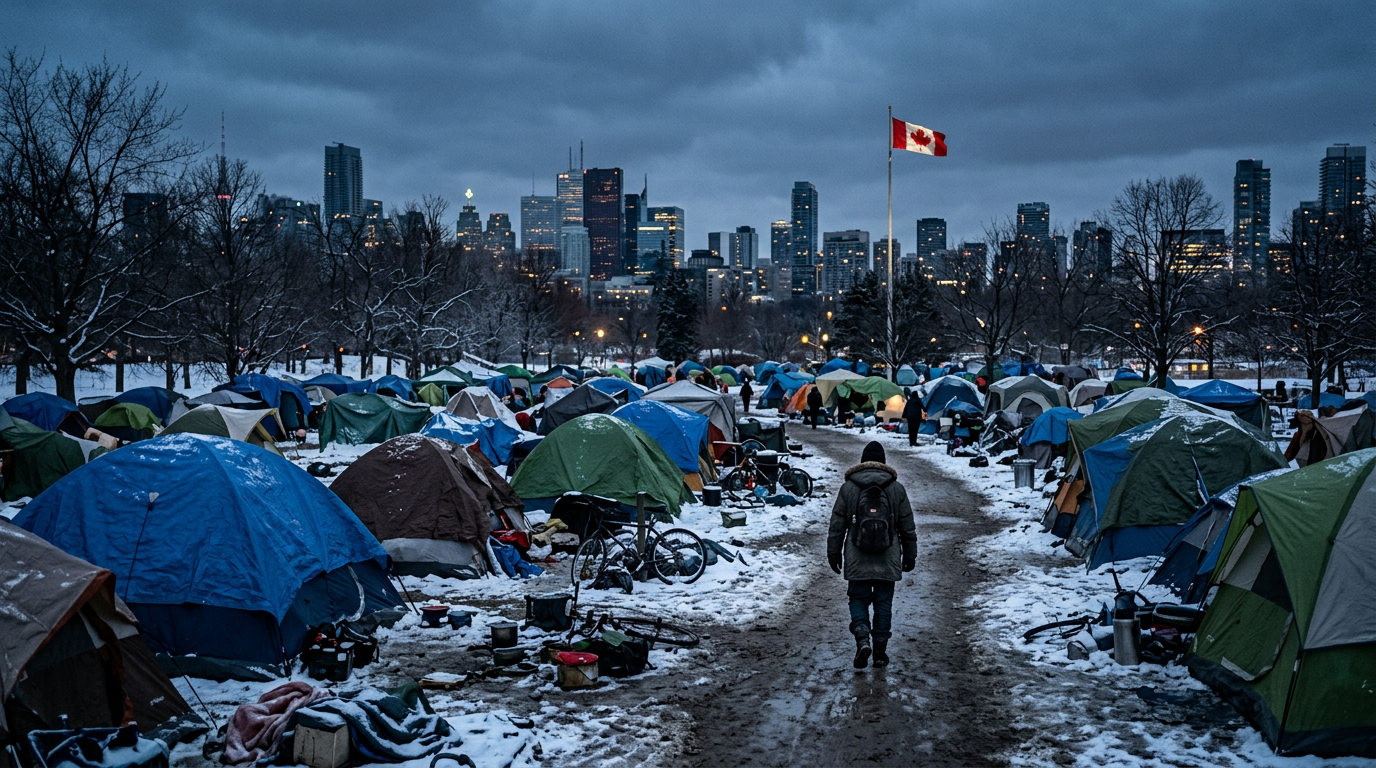

Liberal Plan to End Homelessness? We’ve Heard That One Before!
The Liberals just told us they will end homelessness in 10 years. Mark Carney followed up with the line “In Canada, we take care of each other.” That same government brought in nearly a million non-Canadians while we sit hundreds of thousands of homes short every year. Jobs are dropping, youth unemployment is climbing, hospital waits stretch for months, and food banks are seeing record numbers. The Liberal plan to end homelessness looks like another empty promise dressed up as compassion.
📹 Watch the Video That Sparked This Article
Budget 2026 sets Canada on a path to end homelessness over the next decade with an unprecedented nearly $30 billion. Finance Minister François-Philippe Champagne pointed to the roughly 65,000 people experiencing homelessness on a given night as the reason it is the right thing to do. They are pouring money into supportive and transitional housing through Build Canada Homes, renewing Reaching Home, expanding the Canada Housing Benefit, and building mental health and addictions facilities. Provinces and territories are expected to cover the ongoing operations and services. The federal government covers the capital. That is the plan on paper.
They already spent billions, and homelessness grew.
The Auditor General examined the National Housing Strategy and Reaching Home and found the departments did not know whether the money was making a difference. Infrastructure Canada spent about $1.36 billion between 2019 and 2021 alone. Across the initiatives the Auditor General looked at, roughly $4.5 billion had been spent. Chronic homelessness among shelter users stayed roughly in the 30,000 range for years and then climbed. Unsheltered homelessness and people in encampments roughly doubled.
Shelter use hit around 94,000 in some earlier counts, and later national point-in-time counts put the figure near 65,000 on a single night, up sharply from earlier years. They spent the money, homelessness rose, and they still lack clear measurements and accountability. Now they want to spend roughly six times that amount and call it an end to the problem in a decade.
Housing, jobs, and services are already sliding.
Canada faces a chronic housing shortage. CMHC estimates the country needs between 417,000 and 469,000 new homes every year to restore pre-pandemic affordability by 2036. Under current trends, we are on track for roughly 231,000. That leaves an annual shortfall in the hundreds of thousands and a multi-million home gap over the decade. Immigration levels remain high. Permanent resident targets sit near 380,000 a year, with additional one-time transitions that can push the effective intake much higher in some years.

Temporary resident arrivals are being reduced, but the stock already in the country is large. Population growth from immigration has outpaced housing completions for years. The result is higher rents, tighter vacancy rates at the bottom end of the market, and more people pushed into homelessness. The Liberal plan to end homelessness does not address the supply gap or the pace of new arrivals.
Private-sector jobs fell by 53,000 in October while the overall unemployment rate rose to 6.7 percent. Youth unemployment for ages 15 to 24 climbed to around 13.7%. That is the group that should be starting careers, paying rent, and forming households. Instead, they face the toughest job market in years. Hospital wait times remain brutal.

The Fraser Institute’s 2025 report put the median wait from general practitioner referral to treatment at 28.6 weeks. That is still more than 200% longer than the 9.3 weeks recorded in 1993. People wait months for surgeries and specialist care while the system strains under population growth and staff shortages.
Food Banks Canada’s 2026 HungerCount recorded 2.35 million visits in March alone, up nearly 9% from the previous year and 117% since 2019. Nearly one in five clients is employed. One-third are children. Ordinary Canadians are lining up for food while the government announces another decade-long plan.

Immigration pressure keeps building.
Michelle Rempel Garner pushed back when a reporter tried to pin current immigration problems on the Harper years. Between 2006 and 2013 temporary foreign worker numbers rose, but wages kept pace with inflation, rents were far lower, and a young person leaving college could still see a path to buying a home. Today Mark Carney’s government is running permanent immigration near historic levels while housing starts lag, the economy is soft, and the Bank of Canada has noted wage pressure from high immigration.
The media wanted accountability for a government from twenty years ago. They show far less interest in holding the current one to account while people cannot afford groceries or a place to live. The Liberal plan to end homelessness arrives at the same moment they plan to keep adding large numbers of newcomers without matching housing or infrastructure.
Brampton has already felt the economic hit from other Liberal priorities. The Stellantis Brampton plant faces an uncertain future and potential sale, leaving auto workers, suppliers, and the local economy exposed. Instead of fighting for those jobs, the local Liberal MP has been busy praising Chinese vehicles abroad. The same pattern shows up in housing and homelessness: big announcements, little delivery on the ground for the people already here.
Diwali chaos shows the strain on services and neighbourhoods.

Brampton has a city-wide ban on consumer fireworks. The Indian Immigrants still set them off in streets and driveways anyway, and they get away with it. The city received more than 1,600 service requests around the recent Diwali period, a large share related to fireworks and public nuisance. Fines have already reached tens of thousands of dollars. One garage fire on Cedarbrook Road started after fireworks materials were found inside. Firefighters evacuated a neighbouring home. Streets jammed, 911 lines overloaded, and emergency crews delayed.
That is the extra load on Canadian services. Videos from the area showed garbage left behind after the displays. In other cities, similar scenes played out with fireworks aimed toward police and debris left in public spaces. Australia has taken a harder line on the same celebrations and avoided the same level of street-level chaos. The difference is enforcement and expectations, not some mysterious cultural force.
A separate incident on Crown land near the Terracotta Conservation Area in Caledon saw a group handling rifles casually, pointing them at each other, and firing rounds that whistled over the heads of hikers. No ear protection, no clear range, and repeated warnings ignored. That behaviour has no place on public land where families picnic. These are not isolated clips. They are visible symptoms of rapid demographic change without the matching expectation that newcomers adapt to Canadian safety rules and public order.
Symbols and identity politics reach the kids.
CBC Kids News recently told children that the red poppy focuses too much on soldiers and can be seen as glorifying war. They offered a colour guide:

The Royal Canadian Legion rejects the criticism of the red poppy. Veterans stood together without matching identity checkboxes. Turning a shared symbol of sacrifice into another identity debate for children serves no one who actually served. The same institutions that push these messages are the ones funded by the tax dollars of the people watching their neighbourhoods change and their wait times lengthen.
The Liberal plan to end homelessness is built on the same pattern we have seen for years. Spend more, measure less, promise the impossible, and keep the immigration taps open while housing, jobs, and services lag. Ordinary Canadians are the ones paying the price in higher rents, longer hospital waits, food-bank lines, and neighbourhoods that feel less safe and less orderly.
The $30 billion will not magically produce the hundreds of thousands of homes still missing every year. It will not reverse the job losses or the wage pressure. It will not restore the expectation that public spaces and public safety rules apply to everyone. Until the government matches its rhetoric with results that ordinary people can see in their rent, their paycheque, and their local park, the promise to end homelessness in 10 years remains another line that does not survive contact with reality.
The Real Cost of Empty Promises
The numbers do not lie. Chronic homelessness stayed stubborn or rose while billions were spent. Point-in-time counts show large increases in unsheltered populations since the late 2010s. Food bank visits have more than doubled since 2019. Youth unemployment near 14% means the next generation is starting further behind. Median hospital waits near 29 weeks mean people live with pain and lost productivity for half a year or more. These are not abstract statistics. They are the daily experience of families in Brampton, Calgary, Vancouver, and every mid-sized city that has absorbed rapid population growth without the matching infrastructure.
Carney’s line about taking care of each other sounds warm until you notice who is actually carrying the cost. Working Canadians see their wages lag, their rents rise, and their emergency rooms overflow. The government response is another national plan, another partnership announcement in Winnipeg or Calgary, and another claim that this time the money will be different.
Past Auditor General findings showed departments could not even say whether earlier spending reduced chronic homelessness. The new plan still leaves provinces responsible for the operating costs that keep people housed once the capital is spent. Without strict, public measurement and consequences for missing targets, the Liberal plan to end homelessness risks becoming another spending program that grows the bureaucracy while the tents remain.
Immigration and the Housing Gap
CMHC’s latest supply-gap numbers make the mismatch clear. Even with slower population growth the country still needs roughly 400,000-plus homes a year for a decade to claw back affordability. Current construction runs at about half that pace. Every additional permanent resident and every temporary resident who stays adds demand. The government has talked about reducing temporary arrivals and stabilizing permanent targets, yet the absolute numbers remain large relative to housing completions.
The result is predictable: vacancy rates stay tight at the affordable end of the rental market, rents keep rising for the units people on low incomes can actually reach, and more people fall into homelessness. Blaming previous governments from twenty years ago does not change the arithmetic of today’s arrivals versus today’s starts.
Rempel Garner’s pushback was straightforward. When wages tracked inflation and a house was still reachable for a young graduate, temporary foreign worker growth looked different. Today, the same volume of new people arrives in a market where many young Canadians cannot afford an apartment, let alone a down payment. The Bank of Canada has already flagged the wage effects. Holding the current government to account for the numbers it is choosing right now is not ancient history. It is the policy that is shaping rents and food-bank lines this month.
Neighbourhood Reality in Brampton and Beyond
Brampton’s Diwali experience is a concrete example of the pressure. The city banned consumer fireworks for safety reasons years ago. Enforcement still struggles. Hundreds of complaints, thousands of dollars in fines, and at least one garage fire linked to fireworks materials show the gap between the rule and the street. Emergency services get stretched when streets are blocked and call volumes spike. Neighbouring cities see similar patterns. The same communities that absorb large numbers of newcomers also absorb the strain on policing, fire response, and bylaw enforcement. Australia’s tighter approach to the same festival produced quieter streets. The difference is political will and consistent enforcement, not destiny.
The Crown-land shooting incident near Caledon fits the same pattern. Casual handling of firearms, rounds going over people’s heads, and a lack of basic safety equipment are not cultural enrichment. They are a public-safety failure. Families who use those trails for hiking and picnics should not have to yell for people to stop shooting. When rules are treated as optional, trust in shared public spaces erodes. That erosion shows up in property values, insurance costs, and the willingness of long-time residents to stay.
What Ordinary Canadians Actually Need
Decent wages, homes they can afford, and public services that function are not radical demands. They are the baseline that existed for previous generations. The current mix of high immigration, lagging construction, soft private-sector job growth, and long hospital waits is moving that baseline in the wrong direction. The Liberal plan to end homelessness does not reverse any of those trends. It adds another layer of spending on top of a system that already failed to measure results the last time it spent billions. Until the government ties new money to hard, public targets on housing starts, homelessness counts, and service wait times, and until it matches population growth to infrastructure, the promise remains words.
Canadians who want results should keep watching the tents, the food-bank lines, the job numbers for young people, and the wait times for surgery. Those are the scorecards that matter more than any budget speech.
❓FAQ
Does the $30 billion Liberal plan to end homelessness include clear accountability measures?
The budget language talks about communities providing more consistent data and new bilateral agreements with provinces. Past Auditor General reports showed federal departments could not say whether earlier spending reduced chronic homelessness. Without published interim targets, independent measurement, and consequences for missing them, accountability remains weak.
How does current immigration compare with housing construction?
Permanent resident targets are near 380,000 a year, with additional transitions possible. CMHC says Canada needs 417,000 to 469,000 homes annually to restore earlier affordability. Current construction runs around 231,000. The gap has persisted for years and continues to pressure rents and homelessness.
What happened with Diwali fireworks in Brampton?
Brampton bans consumer fireworks year-round. The city still received more than 1,600 service requests around the recent celebrations, many about fireworks and nuisance. One garage fire involved fireworks materials found on site. Emergency response was strained by volume and blocked streets.
Are hospital wait times improving?
The Fraser Institute’s 2025 median wait from GP referral to treatment was 28.6 weeks, down slightly from the previous year but still more than double the 1993 figure. Waits remain longest in several Atlantic provinces and for orthopedic and neurosurgery procedures.
Why do food-bank numbers keep rising?
Food Banks Canada recorded 2.35 million visits in March 2026, up 117 percent since 2019. Housing costs, food inflation, and wages that have not kept pace for many households are the main drivers. Nearly one in five clients is employed.






Leave a Reply