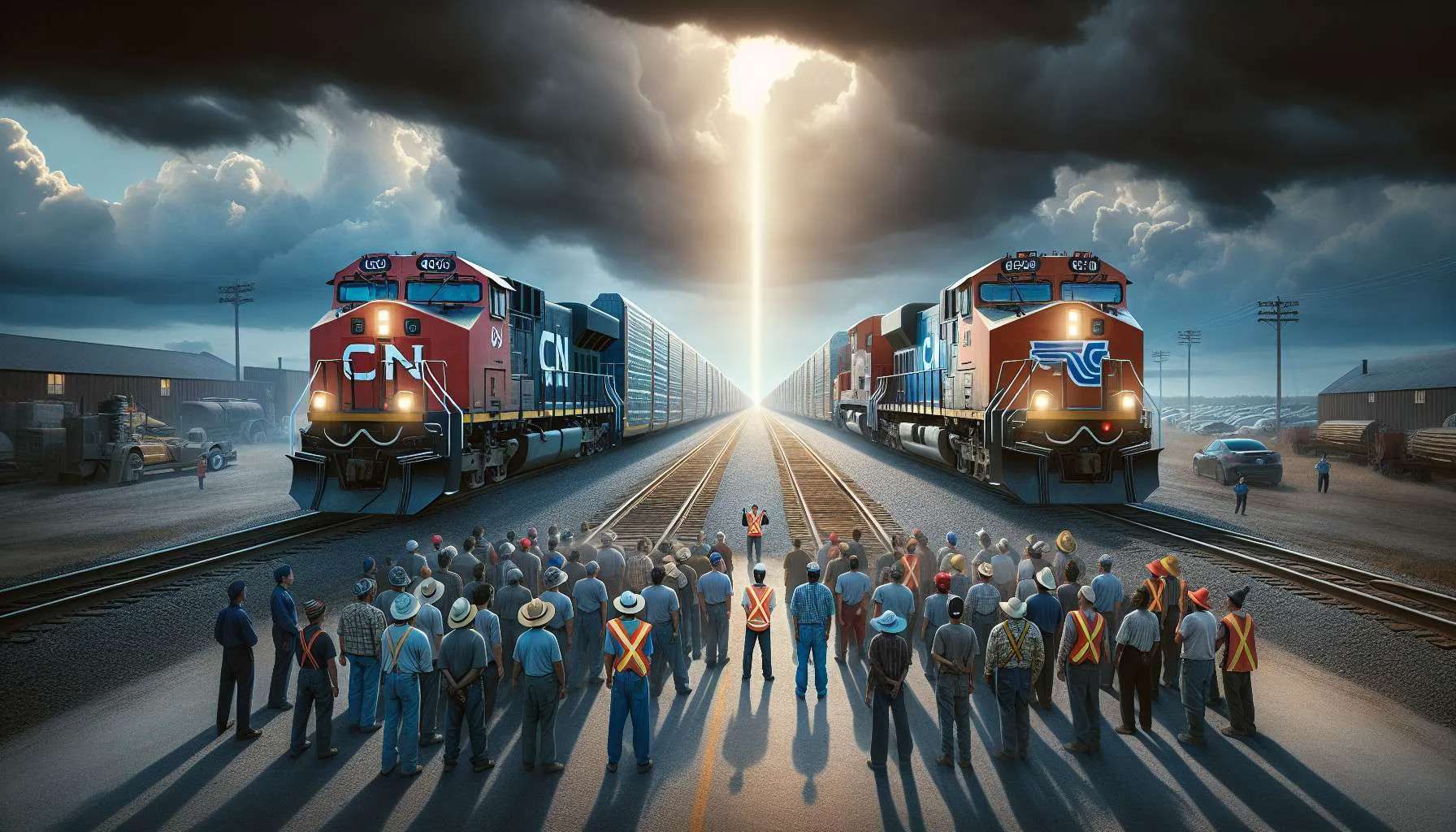
The CN and CPKC Railway Lockout: A Grueling Standoff and Ottawa’s Intervention
The railway freight industry in Canada recently faced an intense upheaval as the Canadian National Railway (CN) and Canadian Pacific Kansas City (CPKC) workers found themselves in a lockout standoff. The entire country held its breath, watching the economic ripple effects of halting such a pivotal component of national infrastructure. The lockout, however, has seemingly come to an end, thanks to Ottawa’s timely intervention.

A Clash of Titans: The Lockout Begins
On August 22, 2024, CN and CPKC took the drastic step of locking out their workers, citing unspecified labour disputes as the initial catalyst. This triggered an immediate logistical nightmare across the country. Supply chains were disrupted, businesses grappled with halted shipments, and everyday Canadians felt the palpable tension of an economic shockwave.
Meanwhile, the situation at CPKC, a recent transnational merger combining Canadian Pacific and Kansas City Southern, added layers of complexity. Could such a conglomerate handle the employees’ grievances without derailing? Clearly, the answer was no, as the lockout spoke volumes about internal management woes.

Ottawa Steps In
The severity of the lockout quickly grabbed the federal government’s attention. Seeing the catastrophic potential of prolonged railway inactivity, Ottawa wasted no time. By stepping in to mediate and essentially enforce an end to the lockout, the Canadian government would relieve the pressure mounting on multiple economic sectors. This move was met with both relief and contention.
The decision laid bare a contentious issue in Canadian politics – the balance between labour rights and economic stability. Prime Minister Justin Trudeau’s administration justified the intervention as a necessary evil to stabilize the nation’s economy. However, not everyone was pleased with this seemingly heavy-handed approach.
Jagmeet Singh’s Opposition

While Ottawa took decisive action, it was met with significant opposition from various political quarters, especially from the New Democratic Party (NDP) Leader, Jagmeet Singh. Singh voiced robust disapproval towards the government’s intervention, arguing that forcing workers back amounted to an infringement on their democratic rights to protest and negotiate better working conditions.
From Singh’s perspective, the government’s action undermined the workers’ ability to secure fair and just employment terms. In fact, he argued that by stepping in, Ottawa essentially emboldened the rail giants to leverage governmental power against their own workforce. Singh’s stance raises an intriguing question: would he maintain this position if the entities on strike were the very ones writing his paychecks? Doubtful, we all know he’s more interested in his own financial future.
Hypocrisy in the Rhetoric?
One has to wonder, given Singh’s intricate political dance. If the situation were reversed and it was the officials and staff members in Singh’s political sphere striking, would his rhetoric remain unwavering? Hypothetically, if faced with a lockout impacting the functioning of political offices that signed his paychecks, Singh could likely find himself walking a thin line between ideology and pragmatism.
In politics, actions often speak louder than words, and this is no exception. As the public scrutinizes Singh’s stance, it serves as a potent reminder of the intricate interplay between labour rights and economic exigencies.
The Road Ahead for Canadian Railways

As CN and CPKC prepare to restart their operations, many questions linger about the long-term implications of this lockout for the Canadian railway industry. Trust between the workforce and management has inevitably eroded, and repair work in both practical and relational realms will be required as they resume normalcy.
The government’s intervention may have been a necessary stopgap, but without addressing underlying labour grievances, recurring disruptions seem almost certain. The railway giants must find a way to bridge the trust chasm, forging agreements that foster collaboration rather than contention.
Conclusion…

The CN and CPKC railway lockout was a stark reminder of the delicate balance between labour rights and economic stability in Canada. Ottawa’s decisive move to intervene has set a precedent likely to reverberate through future labour disputes.
NDP Leader Jagmeet Singh’s opposition added a layer of complexity to the issue, revealing the nuanced and sometimes hypocritical nature of political rhetoric regarding labour unrest. As operations resume, all eyes will be on how both rail companies and the government address the root causes of this high-stakes standoff.
What did you think of this post? Do you agree with Ottawa stepping in to get the trains running again? Share your thoughts in the comments below! If you enjoyed this article, please consider liking and sharing for more content like this.
https://pagead2.googlesyndication.com/pagead/js/adsbygoogle.js?client=ca-pub-0817542680443484
(adsbygoogle = window.adsbygoogle || []).push({});