
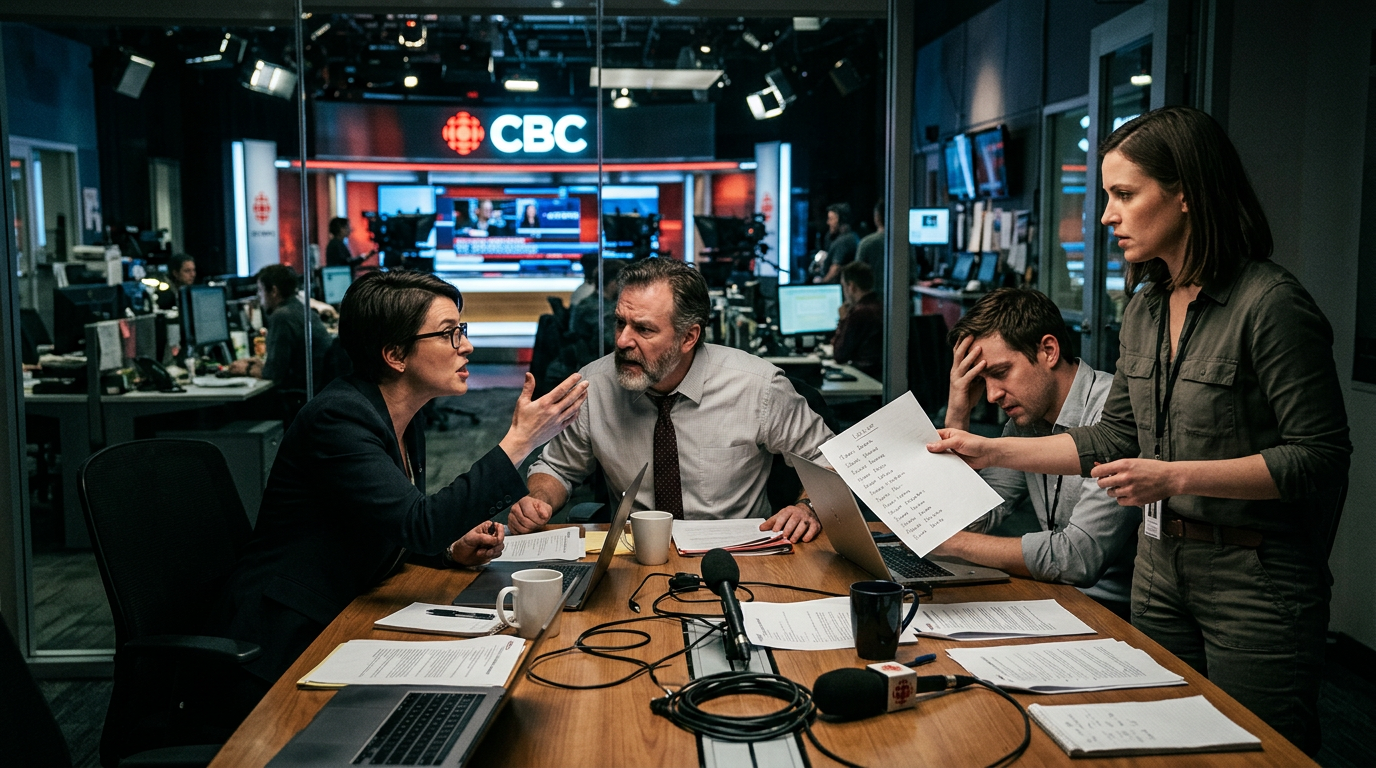
CBC Blacklist Allegations: What Travis Dhanraj’s Testimony Says About Canada’s Taxpayer-Funded Broadcaster

If you want proof that the CBC blacklist controversy is exploding across Canada, you do not need a leaked memo or a whistleblower hiding in the shadows. You only need to listen to testimony that Canadians rarely see on television.
The story is simple. A taxpayer-funded broadcaster that receives roughly $1.5 billion in government funding every year now faces allegations that certain political voices were deliberately blocked from appearing on its programs. (Taxpayer)
That number matters. Canadians are funding this institution through their taxes.
When Canadians pay the bill, Canadians deserve answers.
Instead, Canadians heard testimony about a CBC blacklist of commentators that producers were told to avoid. If that allegation holds even a shred of truth, the implications go far beyond one newsroom.
This becomes a story about power, political influence, and whether a public broadcaster has quietly decided which opinions Canadians are allowed to hear.
And yes, I have questions.
📹 Watch the Video That Sparked This Article
When a Public Broadcaster Picks Sides
The CBC likes to present itself as the voice of Canada. That is the brand. The image. The carefully polished narrative.
Reality looks messier.
Canada’s national broadcaster receives massive taxpayer funding. Government data shows the CBC and Radio-Canada together receive over $1.5 billion annually in public money, making the organization one of the most heavily subsidized media institutions in the country. (Taxpayer)
Supporters say that funding protects Canadian culture. Critics say the funding protects political influence.
That debate has existed for decades.
What has not existed before is testimony suggesting a CBC blacklist may have been used to filter political voices.
If a publicly funded broadcaster is curating the political spectrum that Canadians hear, the entire premise of neutral journalism collapses.
And that brings us to Travis Dhanraj.
The Testimony That Lit a Fire

During testimony on CBC’s internal operations, journalist Travis Dhanraj described his attempt to create panels that reflected real political diversity.
Not diversity of appearance.
Diversity of thought.
That is where the problems began.
Here is what Canadians heard:
“The issue became with the panelists. We had a list of 43 people or 45 people that Power and Politics gave us that said, do not go near these people.”
Read that again.
A list.
A list of people producers were instructed not to book.
According to the testimony, some of those individuals were not fringe commentators. Some were journalists covering major political stories.
Imagine the absurdity.
A reporter covering Queen’s Park during a breaking story cannot appear on a political panel because someone inside a newsroom decided they were on the wrong list.
That is not journalism.
That sounds like gatekeeping.
The Political Imbalance Question
Dhanraj did not claim that panels should be filled with only one political ideology.
He said the opposite.
His goal was balance.
During the testimony, he explained that if Liberal talking points dominate programming, the network has an obligation to bring in other perspectives.
That idea should not shock anyone.
Balanced panels exist across the world. They exist on American television. They exist in Britain.
They exist because political debate requires competing viewpoints.
Without competing viewpoints, debate disappears.
What remains is messaging.
And messaging funded by taxpayers raises an obvious question.
Why are Canadians paying for it?
The Broadcasting Act Problem
During the testimony, Dhanraj made another statement that should make Canadians pause.
He said the situation may violate Section 11 of the Broadcasting Act, which requires public broadcasters to represent a range of perspectives.
That law exists for a reason.
Public broadcasters are supposed to serve everyone.
Not one ideology.
Not one political party.
Everyone.
If internal decisions prevented certain viewpoints from appearing, the issue ceases to be a newsroom dispute and becomes a matter of public accountability.
The $1.5 Billion Question

Every year, Canadians fund the CBC whether or not they watch it.
The money flows through federal funding, approved by Parliament.
In recent years, the public subsidy has hovered around $1.3 to $1.5 billion annually, making it one of the largest publicly funded media organizations in the Western world. (Policy Options)
Supporters argue this funding protects Canadian content and independent journalism.
Critics see something different.
They see a government-funded media outlet that rarely challenges the political establishment responsible for signing the cheques.
That perception has existed for years.
Now, testimony about a potential CBC blacklist adds gasoline to the fire.
Why Canadians Should Care
This is not about whether someone likes the CBC.
This is about whether taxpayer-funded media institutions operate transparently and fairly.
A private news outlet can choose its editorial direction.
That is their right.
A public broadcaster operates under a different standard.
Taxpayer funding carries an obligation to represent the full range of public debate.
When allegations surface suggesting certain viewpoints were blocked, Canadians deserve clarity.
Not spin.
Not corporate messaging.
Clear answers.
Media Power in Canada
Canada has one of the most concentrated media landscapes in the Western world.
A small number of corporations dominate television, radio, and print.
The CBC sits at the center of that ecosystem.
It is not a small player.
It is a massive institution with thousands of employees and a nationwide reach.
When such an institution shapes political conversations, its influence becomes enormous.
That is why questions about a CBC blacklist matter.
Because the conversation Canadians hear shapes the democracy Canadians live in.
The Silence Around the Story
Here is the strange part.
Stories about media bias often dominate headlines.
Stories about media institutions themselves rarely receive the same treatment.
When journalists become the subject of scrutiny, coverage suddenly grows quiet.
Why?
Perhaps because investigating the media requires the media to investigate itself.
And that is never comfortable.
My Take
I do not believe any media organization should operate beyond scrutiny.
Not the CBC.
Not private networks.
Not independent outlets.
Journalism survives through transparency.
When transparency disappears, trust disappears.
And when trust disappears, audiences walk away.
The CBC has spent decades building its reputation as Canada’s national broadcaster.
If allegations about a CBC blacklist are accurate, that reputation faces a serious test.
Canadians deserve an answer to a simple question.
Did a taxpayer-funded broadcaster attempt to shape political debate by deciding which voices Canadians could hear?
Because if that happened, the story is far bigger than one newsroom dispute.
It becomes a story about democracy.
Why This Story Matters to Me
I write about Canadian politics because I believe Canadians deserve to know what happens behind the curtain.
Too many institutions operate without scrutiny.
Too many decisions happen quietly while taxpayers pay the bill.
That is why stories like this matter.
The issue is not whether someone agrees with one political viewpoint or another.
The issue is whether Canadians are allowed to hear all viewpoints in the first place.
If a CBC blacklist existed, that principle was violated.
And that deserves national attention.
Where This Leads

The controversy surrounding CBC funding and political bias will not disappear overnight.
Calls to reform or defund the broadcaster have existed for years.
Now, testimony about internal editorial decisions adds a new dimension to the debate.
This conversation will continue in Parliament.
It will continue among journalists.
And it will continue among Canadians who are asking the same question I am asking.
Who decides which opinions Canadians are allowed to hear?
POLL:
Related Reading
For more discussion about government transparency and institutional accountability, read my earlier article:
👉 Canada Corruption and Government Failure
https://macsopinion.com/2026/02/08/canada-corruption-and-government-failure/
The pattern of secrecy and political influence appears in more places than Canadians realize.
FAQ:
What is the CBC blacklist controversy?
The CBC blacklist controversy refers to testimony suggesting certain commentators were allegedly placed on internal lists that producers were told not to invite onto political programs.
How much taxpayer funding does CBC receive?
CBC and Radio-Canada together receive roughly $1.3–$1.5 billion annually in federal funding.
Who is Travis Dhanraj?
Travis Dhanraj is a journalist who provided testimony describing internal editorial decisions at CBC related to political panel guest selection.
Why does CBC funding spark debate in Canada?
Because the broadcaster receives public funding, critics argue it must represent diverse political perspectives and remain politically neutral.




Leave a Reply