
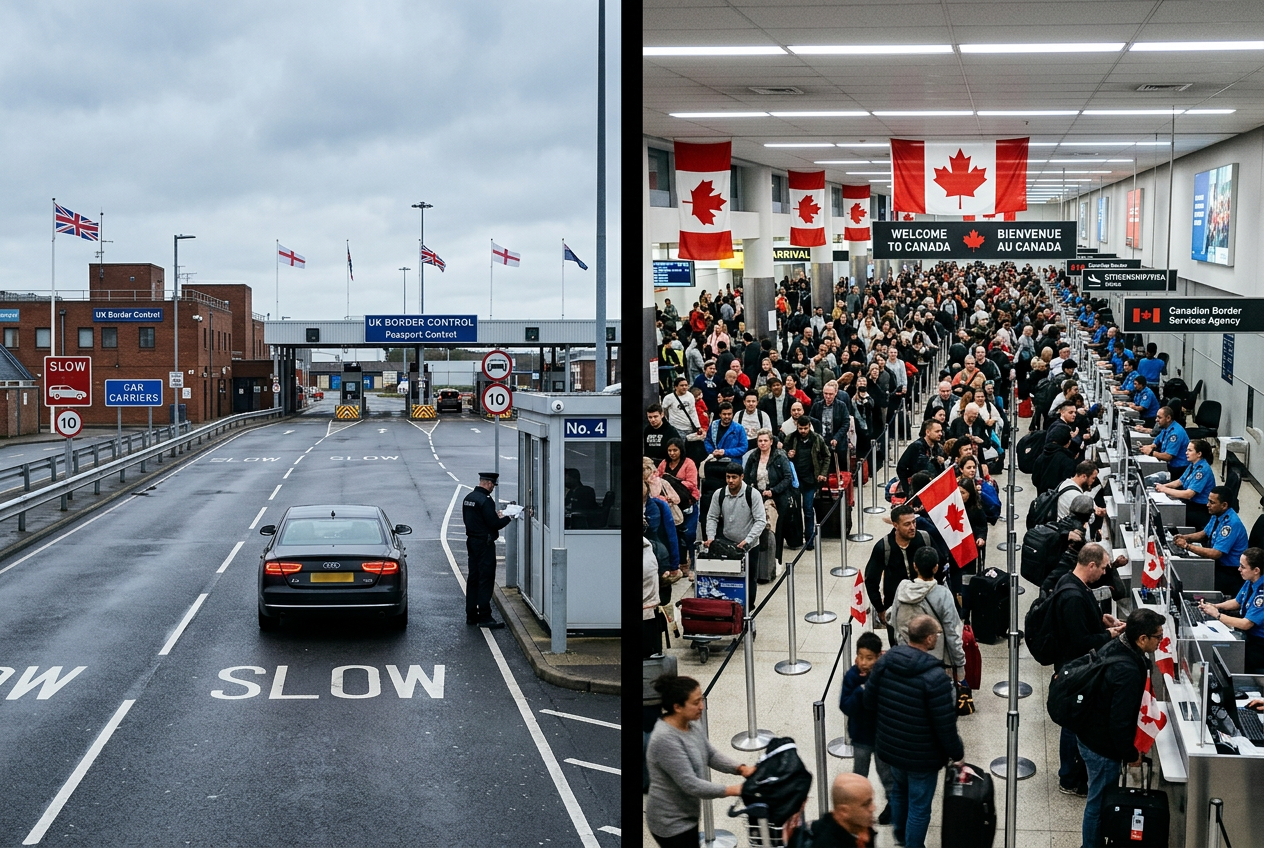

Britain Slammed the Brakes on Net Migration. Mark Carney’s Immigration Levels Just Floored the Accelerator in Canada.
I watched the numbers drop in Britain and felt that familiar mix of envy and rage. Even though there are still way too many migrants, net migration into the UK fell to 171,000 in the year ending December 2025, nearly half the 331,000 recorded the year before, according to the Office for National Statistics. Official forecasts now point toward 120,000, a level not seen since 1997 outside the pandemic years.
The method was simple: tighten visas and actually say no. Meanwhile, back home under Mark Carney, Canada is handing out a record near 660,000 permanent residencies next year. After that, it settles into 380,000 permanent residents plus 370,000 temporary residents every single year. One country actually listens when its people speak. We just floored the accelerator.
I have been tracking this for months, and the contrast is brutal. The Office for National Statistics confirmed the UK drop, driven mainly by a 47 % fall in non-EU work arrivals. They tightened the rules, raised thresholds, and stopped treating every applicant as a future permanent resident. The Office for Budget Responsibility projects the figure sliding toward that 120,000 mark. It is not zero. It is not perfect. It is a country choosing control over chaos.
What Britain Actually Did With Net Migration
Britain did not invent a new philosophy. It simply stopped pretending that unlimited inflows are free. Visas got harder. Family routes narrowed. Work permits faced real salary floors. The result showed up in the data within a single year. Long-term immigration fell to 813,000 while emigration held at 642,000, producing that 171,000 net figure. Non-EU nationals still dominate the remaining positive flow, but the overall volume is no longer exploding.
I keep asking myself why Ottawa cannot do the same. Canadians have been clear for years that the pace is too high. Housing is unaffordable. Hospital corridors are full. Young people cannot find starter jobs. The response from Mark Carney’s government has been to redefine “sustainable” until it means whatever number keeps the GDP line looking pretty on a chart. That is not listening. That is gaslighting.
Canada Immigration Levels Under Mark Carney: The Real Numbers
The official 2027–2029 Immigration Levels Plan from IRCC sets permanent resident admissions at 380,000 a year and new temporary resident arrivals at 370,000 a year. That alone is 750,000 people entering the system annually. On top of the base target, Budget 2026 created a time-limited measure to transition up to 200,000 temporary residents already in Canada to permanent status by the end of 2027. Add the remaining portion of earlier one-time initiatives for protected persons and workers, and CBC reported the total new permanent residencies next year approaching 660,000. Pierre Poilievre put the figure at 657,250. The Hub calculated up to 662,000. Call it a record. Call it reckless. Do not call it a reduction.
I covered the accounting tricks in my earlier piece on Mark Carney immigration admissions. The base 380,000 looks controlled until you notice the extra pathways sitting outside the headline target. Temporary residents become permanent residents without ever being counted as “new arrivals” in the way ordinary Canadians understand the term. The government then claims it is bringing immigration under control. It is not. It is converting the backlog into permanent status while keeping the front door open for another 370,000 temporary residents every year.
The Temporary Residents Pipeline Keeps Running
Those 370,000 new temporary residents break down into roughly 220,000 workers and 150,000 students. Many of them will later convert. The system is designed that way. Employers get cheap labour. Colleges get tuition. Ottawa gets the population growth that flatters the GDP number. Ordinary Canadians get the bill for housing, healthcare, and social services that never scale at the same speed.
Housing Starts Cannot Keep Up With Canada’s Immigration Levels.
CMHC forecasts housing starts falling to about 223,000 in 2027 and lower still in 2028. The same agency says Canada needs 417,000 to 469,000 starts a year to restore pre-pandemic affordability by 2036. We are building less than half of what is required while population growth stays elevated. Internal government briefings have already admitted the old 500,000-home target is out of reach this decade, with immigration-driven demand listed as one of the obstacles.
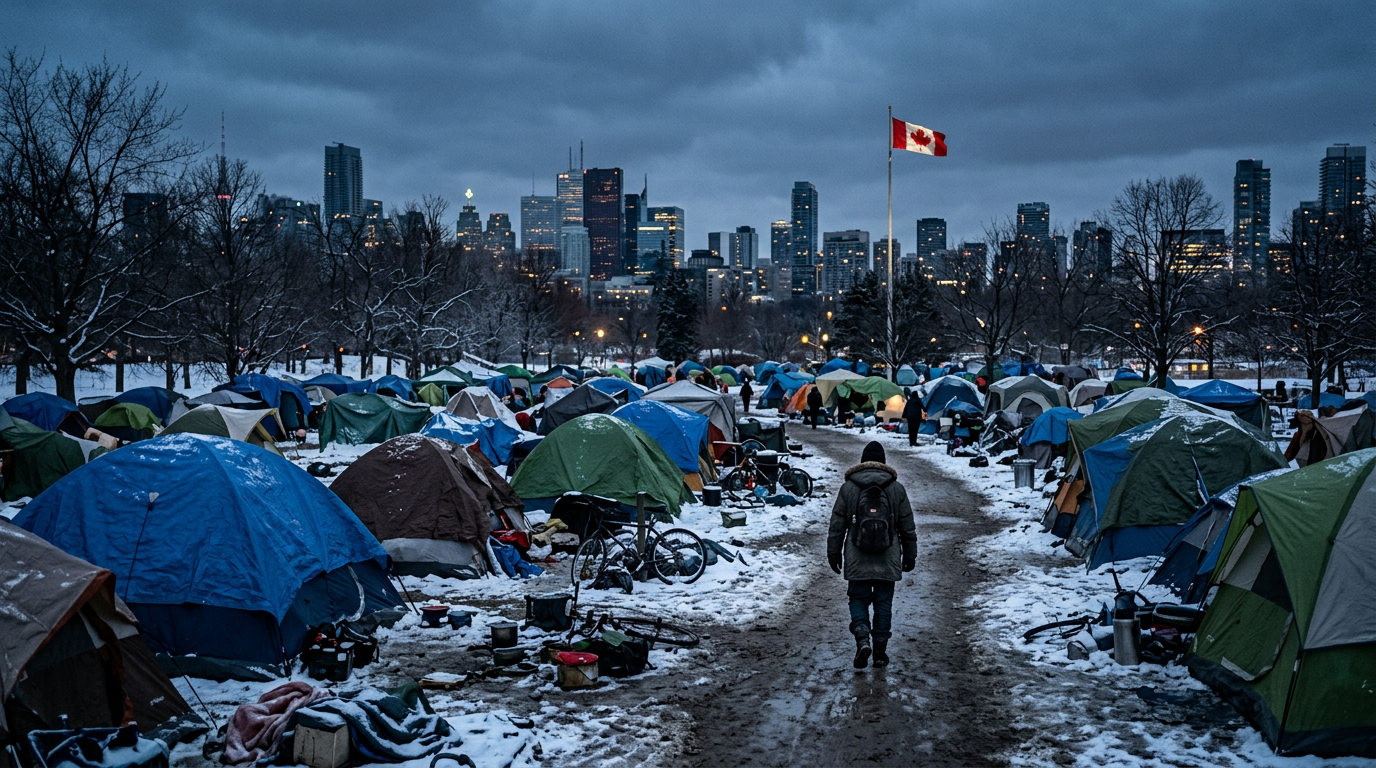
I talk to people who cannot find a place to rent in Calgary or the GTA. Young couples who delayed kids because the mortgage numbers never work. Seniors who sold the family home and now compete with newcomers for the same limited stock. The government talks about building more, then delivers forecasts that show construction declining. It is not a coincidence. You cannot add a Mississauga-sized population every year and expect the housing market to absorb it without pain. The pain is already here. Rents are high. Homeless encampments grow. Food bank lines get longer.
Healthcare Waits Get Worse When Population Outruns Capacity
CIHI data shows emergency department wait times have lengthened across the country. Patients with urgent conditions still get priority, but overall length of stay is up. In some provinces, the median wait from referral to treatment stretches past a year. Family doctors are scarce. Millions of Canadians have no regular primary care provider. Adding hundreds of thousands of new permanent and temporary residents each year increases demand for doctors, hospital beds, and emergency rooms that are already stretched.
I have watched friends sit for hours in ER waiting rooms. I have heard stories of cancelled surgeries and people giving up on finding a family doctor. People DYING in waiting rooms! The Liberals respond by pointing to a few targeted streams for internationally trained physicians. That is a drop in the bucket. It does not fix the broader capacity problem created by rapid population growth. Healthcare is not an infinite resource. When you expand the patient base faster than the system can train and retain staff, ordinary Canadians wait longer and get less.
Jobs, Wages, and the Cost for Young Canadians
Youth unemployment sits near 13.7 %. Teen unemployment has been far higher. Reports from the C.D. Howe Institute and others note that non-permanent residents increased competition for entry-level work. Temporary foreign worker rules still allow low-wage positions in many areas, even with some local unemployment thresholds. At the same time, food bank usage hit a record 2.35 million visits in March 2026, according to Food Banks Canada’s HungerCount, up 117 % since 2019. Nearly one in five clients is employed. People who have lived in Canada for ten years or less now make up a larger share of clients than they did before the recent surge.
I do not blame individuals who take the opportunities Ottawa offers. I blame the policy that imports labour while young Canadians and recent graduates struggle to find hours and wages that cover rent. The government claims labour shortages. The data shows youth joblessness and food bank lines filled with working people. Those two things cannot both be true at the scale we are seeing.
Why the Liberals Keep the Pedal Down
Mark Carney and his ministers keep calling the plan “sustainable.” They point to reductions in new student and temporary foreign worker arrivals compared with the absolute peaks. They ignore that the absolute numbers remain among the highest in modern Canadian history and that conversion pathways push permanent residency totals higher still. Population growth flatters GDP. New permanent residents become voters. Temporary residents fill low-wage jobs that keep certain industries profitable. The costs land on existing residents through higher rents, longer waits, and thinner public services.
I have said this before, and I will keep saying it. This is not about race or culture. It is about numbers, capacity, and priorities. A country that cannot house or treat its existing population has no business importing another 750,000 people a year plus massive conversion streams. Britain showed that a single year of tighter rules can cut net migration nearly in half. Canada under Carney is doing the opposite.
Ordinary Canadians Pay the Price
The real-world impact is visible every day. A young couple in Ontario spends half their income on rent and still cannot save for a down payment. A senior in British Columbia waits months for a specialist while emergency rooms run over capacity. A recent graduate in Alberta applies for entry-level retail jobs that never call back. Food banks report record demand and still run short. These are not abstract statistics. They are the direct result of immigration levels that outrun housing, healthcare, and job creation.
The Choice Is Still Open
Britain proved the numbers can move quickly when a government decides to say no. Canada has the same tools. We can raise thresholds, reduce temporary pathways, and stop converting the existing temporary population into permanent residents at record speed. The alternative is more of the same: rising rents, longer hospital waits, and a generation of young Canadians who feel locked out of the country their parents built.
I am not asking for zero immigration. I am asking for numbers that match our capacity to house, employ, and care for people. (Also vetted migrants who bring value, not ones who can just pour a coffee) The current Canada immigration levels under Mark Carney do not meet that test. They ignore the evidence from our own housing agency, our own healthcare data, and our own food bank reports. They ignore what Britain just demonstrated is possible. The accelerator is still floored. Ordinary Canadians are the ones hitting the wall.

❓FAQ:
Britain tightened visa rules, raised income thresholds for family routes, and reduced work-related arrivals from outside the EU. The Office for National Statistics recorded the drop to 171,000 in a single year.
Yes. The base 380,000 target plus up to 200,000 temporary-to-permanent transitions and remaining earlier one-time measures produce figures reported between 650,000 and 662,000 new permanent residencies in 2027.
New temporary resident arrivals are set at 370,000 a year, but many convert later. Those conversions often sit outside the main permanent resident target, so the official “controlled” number understates the total.
Housing starts lag behind population growth, hospital and emergency waits lengthen, youth unemployment remains elevated, and food bank use has more than doubled since 2019.



Leave a Reply