

Carney Cadet Cuts, What’s Next?
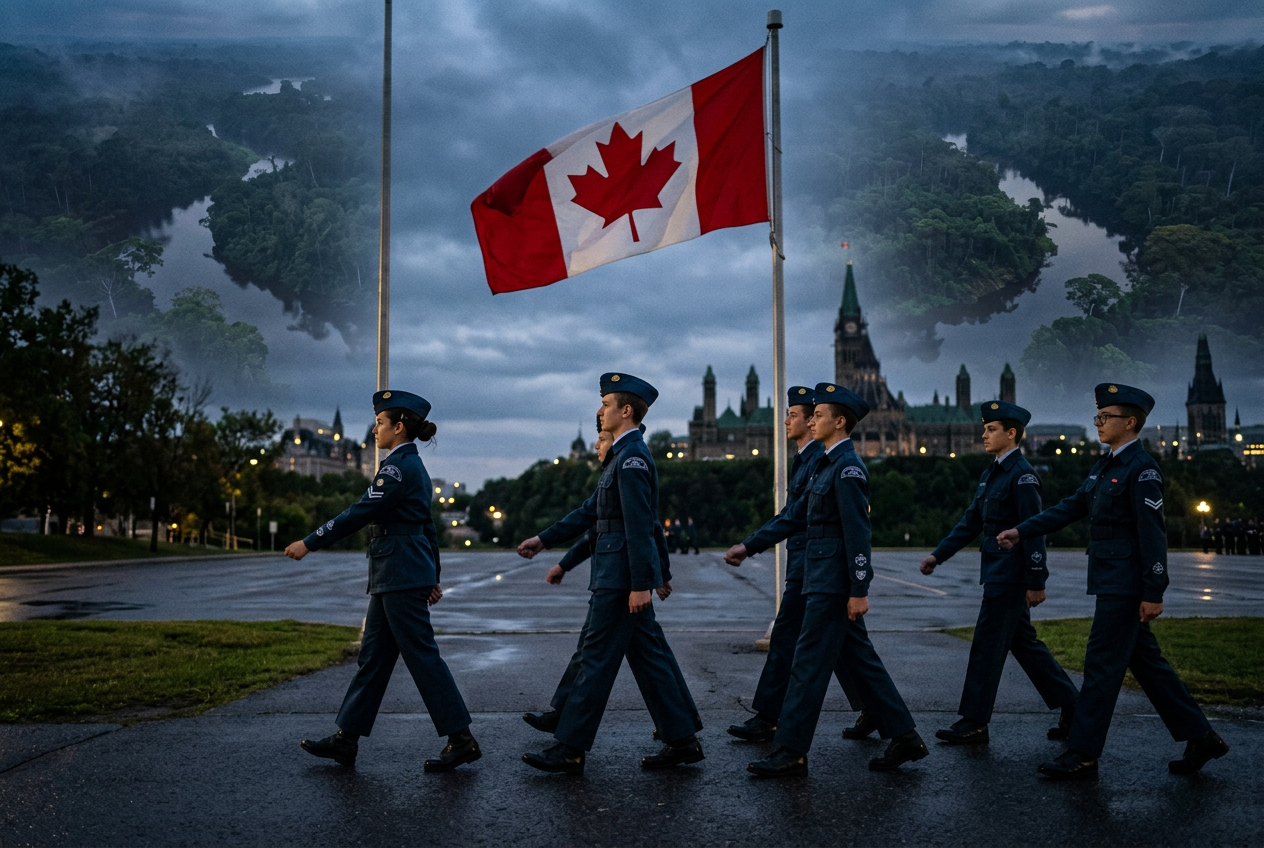
I watched Mark Carney smile for the cameras in Manila and felt the familiar chill of another Liberal priority gone wrong. He pledged up to $560 million over four years to a Brazilian-led tropical forest fund while the Canadian Armed Forces ordered most weekend cadet activities paused until March 2027. Carney cadet cuts arrived the same week ordinary Canadian families were told the fiscal environment required restraint at home. Those kids who march on Remembrance Day, learn discipline, and pick up real skills are being asked to stand down so Ottawa can fund trees on the other side of the planet.
That contrast is not subtle. It is the latest proof that this government treats Canadian youth programs as optional while treating international climate announcements as non-negotiable. I remember what the cadet program gave me. It is not something I am willing to watch get quietly hollowed out.
Hear It Straight: Why These Cadet Cuts Matter

I was an Air Cadet. That is where I learned to read music, play instruments, handle a rifle safely, and eventually fly gliders. The program also drilled in respect, outdoor survival, public speaking, and the simple habit of showing up prepared. Those are not soft extras. They are the exact habits a lot of Canadian youth are missing right now. When Ottawa decides the Canadian cadet program can absorb “adjustments,” I hear the sound of another generation being short-changed.
The federal government has decided funding pressures mean weekend training, competitions, and many of the activities that make the program attractive must pause in multiple regions. Weekly parade nights can continue for now. That is not enough. The lessons that last a lifetime come from the full range of training, not from drill nights alone.
What the Canadian Cadet Program Actually Delivers

The Canadian cadet program is not a forced recruitment pipeline into the military. Most participants never join the Canadian Armed Forces. What they receive is structure, teamwork, outdoor competence, accountability, and a place to belong that sports teams or arts classes sometimes cannot offer. Air cadets learn aviation basics and often get glider flights. Army cadets master map and compass work, first aid, and expedition skills. Sea cadets pick up seamanship and powerboat handling.
Across all three elements the common thread is discipline and community service. Not every cadet stays for years. Some leave after a season. The ones who remain pick up habits that transfer to classrooms, workplaces, and later careers as police officers, paramedics, firefighters, and community leaders. Odds are you know someone who was or still is a cadet.
CBC News reported that leaked emails ordered units to pause most weekend activities until 31 March 2027 because of the current fiscal environment. The Department of National Defence says the overall allocation sits at about $265 million after an earlier top-up, yet operational savings targets still force these cuts. When more than 72,000 young Canadians aged 12 to 18 are enrolled, with over 16,000 more on waitlists, slashing the parts that keep kids engaged is a self-inflicted wound.
Carney Cadet Cuts Meet the Brazilian Tropical Forest Fund
The contrast could not be sharper. On 15 November 2026 Carney announced the initial contribution of up to $560 million over four years to the Tropical Forests Forever Facility co-led by Brazil and Norway. Reuters confirmed the figure and CBC carried the same details. The money forms part of Canada’s larger pledge to deliver more than $13 billion in international climate finance to developing countries by 2031. The facility aims to protect more than one billion hectares of tropical forest across more than 70 countries.
Nobody disputes that tropical forests matter on a global scale. What ordinary Canadians are allowed to ask is why protecting trees in the Amazon ranks higher than protecting the youth programs that have operated here for more than a century. The Sea Cadets date back to the 19th century. Air Cadets began during the Second World War. These are long-standing, free programs that produce capable adults. When I stood on Remembrance Day and watched cadets march in step, I saw the results of consistent funding and volunteer effort. Now those same kids are told the extras must stop so the fiscal environment can be respected.
Here is the part that should make every Canadian’s head spin. A few years ago, while Mark Carney was Vice Chair and Head of Transition Investing at Brookfield Asset Management, the firm was linked to the clearing of roughly 9,000 hectares of Brazil’s Cerrado savanna for soybean farms. Global Witness documented the deforestation and the BBC reported on the sale of those farms. Carney spent years lecturing the financial world that companies should not simply sell off climate-damaging assets. Then his firm sold the farms anyway.
So is this half-billion-dollar commitment to the Brazilian tropical forest fund his way of cleaning up the mess his own company helped create? Who knows with this Liberal circus. The same man who now presents himself as a global climate saviour once sat at the top of an organization accused of bulldozing biodiverse land bordering the Amazon. Ordinary Canadians are supposed to applaud the cheque while the kids in cadets lose weekend training. The irony is thick enough to cut with a chainsaw.
The Broader Pattern of Liberal Priorities
This is not an isolated decision. I wrote earlier about how Carney’s first year failed the grocery-store test he set for himself. Housing stayed unaffordable, prices kept climbing, and street-level disorder continued while Ottawa chased international headlines. You can read that full accounting in my piece on Carney’s first-year failure. The same government that found hundreds of millions for a Brazilian forest fund is also managing Department of National Defence operational savings of $459 million this fiscal year and another $459 million next year.
Defence Minister David McGuinty’s office talks about unprecedented funding for the military. The practical effect on the Canadian cadet program is weekend training cancelled in Ontario and British Columbia. Budget 2026 added $11.2 billion in new defence spending over five years, a sharp slowdown from earlier plans. Much of that money is reallocated rather than truly new. Core defence spending is projected to reach 2.6% of GDP and then flatline well short of the 3.5% NATO target Canada accepted.
Of course I am not saying that Canadian Defence is not important; I’m just pointing out the cost. Meanwhile, the cadet side of the house, which costs a fraction of a single major procurement, is the one told to pause activities.
That ordering of priorities reveals more about Liberal foreign aid habits than any speech about Canada’s responsibility to the planet. Carney cadet cuts are the domestic price of those habits.
Real Impact on Canadian Youth and Communities
When the program is popular enough that waitlists exist in many communities, cutting the weekend training and competitions that make it fun is how you turn a success story into a slow decline. Parents already juggle work, school, and extracurriculars. If the most appealing parts of the Canadian cadet program disappear for half a year, some kids will simply stop coming. The volunteer officers who give up their evenings and weekends will burn out faster. The leagues that support local corps and squadrons will face harder fundraising asks.
All of that happens while Ottawa wires money abroad for a fund that will not train a single Canadian teenager how to read a map or fly a glider. Some former cadets become the police officers and paramedics who respond when something goes wrong in your neighbourhood. Others simply become the reliable adults who coach minor hockey or run community events. Those outcomes do not appear by accident. They appear because the program was funded well enough to keep kids engaged long enough for the lessons to stick.
I cannot overstate how valuable this is for so many young people who do not fit neatly into sports or arts programs. They found a home in cadets. Now we are letting them down. Some become leaders in their communities. The odds are high that you know one of them. Watching the results on Remembrance Day only makes the funding pause feel more insulting.
Why the “Sorry, Here’s Your Handout” Approach Has to Stop
Canadians have watched successive Liberal governments treat foreign aid and climate finance as moral obligations that sit above domestic programs. The $560 million to the Brazilian tropical forest fund is only the latest example. It arrives while food bank use stays high, housing starts lag population growth, and youth programs that teach actual Canadian skills face operational cuts. I am not arguing that Canada should ignore the rest of the world. I am arguing that a country that cannot keep its own popular, effective youth programs fully funded has no business treating overseas tree funds as the higher priority.
Over 70,000 youth are in the system right now. That number is large enough that almost every Canadian knows a former or current cadet. Those young people show up on Remembrance Day in uniform, lay wreaths, and stand at attention while the rest of us watch. They do the work of honouring the fallen without demanding anything in return except the chance to keep learning. Pulling resources from that program while expanding international climate commitments is the opposite of Canada first. It is Ottawa first, and then everyone else.
How dare the federal government yank meaningful activities from our youth and our future while handing money away like candy to other countries? This has to stop. Canadians need to quit the sorry-here-is-your-handout routine and put money back into programs that actually matter here. The Canadian cadet program is one of those programs. Carney cadet cuts prove the current government still has not learned that lesson.
What Needs to Happen Next
The temporary pause until March 2027 is not the end of the story. Once the fiscal year turns over, nothing guarantees the activities return at full strength. The same savings pressures will still exist. The same preference for international announcements over domestic delivery will still exist. Canadians who care about these kids need to make noise now.
Contact your Member of Parliament. Ask why the Canadian cadet program is absorbing operational cuts while the Brazilian tropical forest fund receives a multi-year commitment measured in the hundreds of millions.
I remember the first time I marched with my squadron. The uniform felt stiff, the rifle was heavier than I expected, and the drill instructor had no patience for sloppy turns. By the end of the year, I could play in the band, handle basic survival tasks, and speak in front of a room without freezing. By the 3rd year, I was flying gliders! Those skills did not come from a government press release. They came from consistent funding, volunteer adults, and a program that treated Canadian youth as worth the investment. Carney cadet cuts threaten exactly that investment.
We can do better. We have done better for more than a century. It is time to stand with the cadets the same way they have stood for the rest of us. The youth leadership programs that build discipline, respect, and practical skills deserve priority over another round of overseas climate financing. Ordinary Canadians see the difference. Ottawa should too.

❓FAQ:
What exactly did the federal government cut in the cadet program?
Weekend training, competitions, and many optional activities are paused until 31 March 2027 in multiple regions because of Department of National Defence operational savings targets. Weekly parade nights are currently allowed to continue. The overall budget remains approximately $265 million.
How much money is Canada sending to the Brazilian tropical forest fund?
Up to $560 million over four years to the Tropical Forests Forever Facility, announced by Mark Carney on 15 November 2026. The contribution counts toward Canada’s broader climate finance pledge of more than $13 billion by 2031.
How many young Canadians are in cadets right now?
Recent figures show more than 72,000 participants aged 12 to 18 in the Cadet and Junior Canadian Ranger programs, with more than 16,000 additional youth on waitlists.
Do cadets have to join the military?
No. The program is civilian. Participants are not members of the Canadian Armed Forces and face no obligation to enlist. Many go on to civilian careers in policing, emergency services, trades, and community leadership.
Why are people calling these decisions Carney cadet cuts?
Because the pause in activities occurred under the current Liberal government led by Mark Carney, at the same time the government announced large new international climate commitments, while DND continues to meet inherited operational savings requirements.


Leave a Reply